
Apartment Living & Ham Radio
Limited space. Real-world restrictions. Plenty of ways to get on the air.
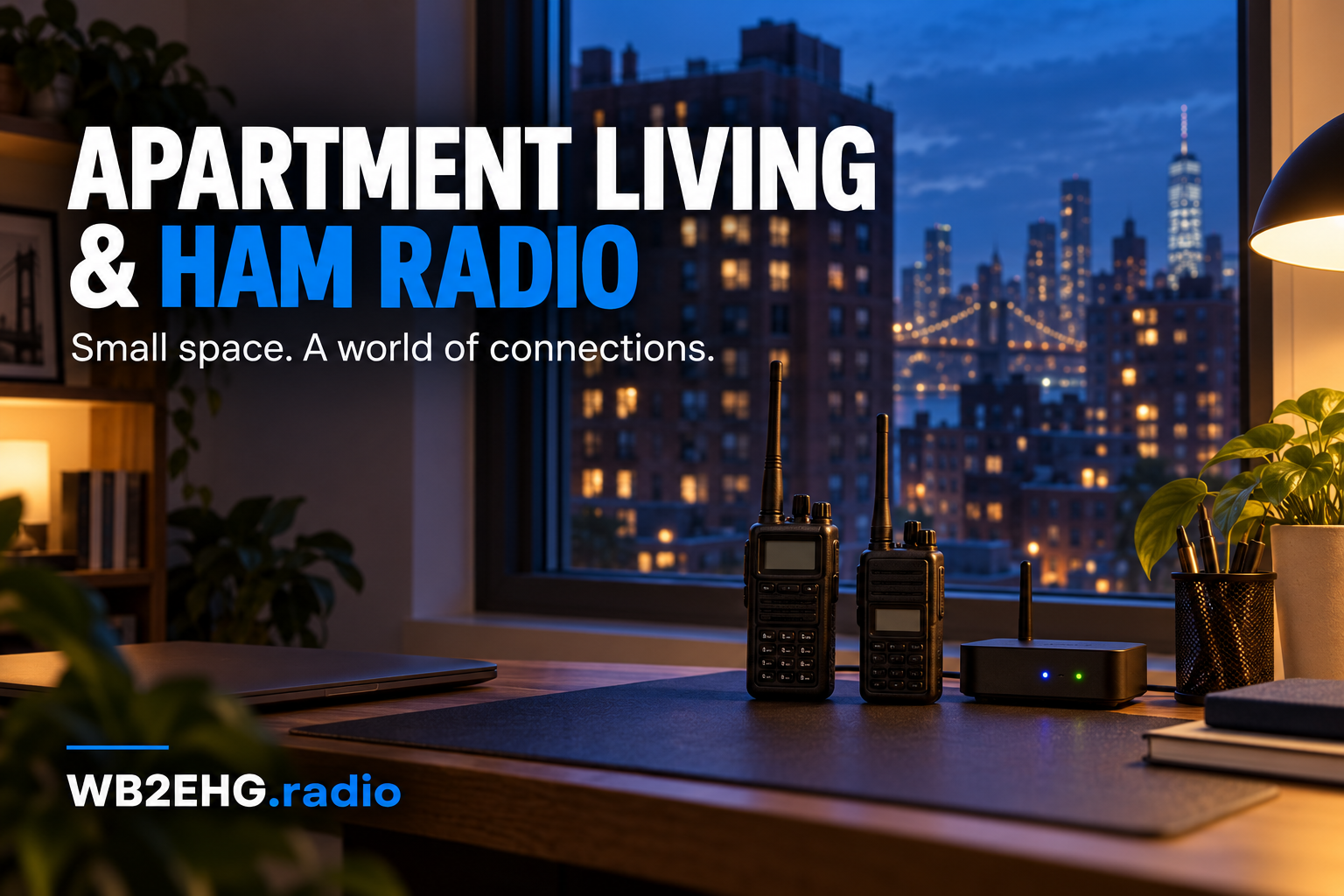
Illustrative image created with AI; equipment and apartment view are representative.
I operate amateur radio from a 17th-floor apartment in Brooklyn. I have no outdoor antenna, limited space, and a budget that requires making thoughtful choices.
I also talk with other amateur-radio operators locally and around the world, experiment with digital communications, and develop skills that can support emergency communications.
Apartment living shapes how I operate. It hasn’t stopped me from enjoying the hobby.
If you live in an apartment, condo, or another home where a traditional antenna installation isn’t possible, there is room for you in amateur radio.
Start With What You Want to Do
Before buying equipment, think about what interests you. Talking with local operators? Joining nets? Meeting people around the world? Learning about emergency communications? Experimenting with antennas and digital modes?
Each goal suggests a different starting point.
A handheld radio may give you access to nearby VHF and UHF repeaters. A compatible digital radio and an internet-connected hotspot can open up worldwide conversations. Listening is valuable in its own right, and portable operating lets you explore possibilities beyond your apartment.
You don’t have to build every capability at once. Choose something you want to do, get comfortable doing it, and grow from there.
Local Radio From Inside an Apartment
Much of my station revolves around handheld radios operating on VHF and UHF, including the popular 2-meter and 70-centimeter amateur bands.
Two useful ways to communicate are:
Repeaters: Stations that receive your signal and retransmit it, potentially extending your coverage.
Simplex: Direct communication between radios without a repeater.
A handheld can be a useful starting point, but results depend on your surroundings. Building materials, nearby structures, antenna placement, and the location of the other station all matter.
Being seventeen floors up gives me height to work with. It also leaves a building between my antenna and some of the places I want to reach.
Start by listening. Learn when local repeaters are active, then identify with your callsign and ask for a radio check. Hearing a repeater is encouraging; getting a clear report back tells you more about whether your station can communicate through it.
For local starting points, visit my Brooklyn Amateur Radio Repeaters page.
Work With the Space You Have
Before buying another antenna, experiment with the location of the one you already own.
Try different positions inside the apartment and compare the results. A window is worth testing, but it isn’t a guarantee. Keep notes about where you were operating, which antenna you used, and what the other operator reported. Change one thing at a time so you can tell what helped.
Indoor antennas are a legitimate part of amateur radio. They can interact with nearby wiring and other objects, so an installation may need adjustment to work well. ARRL has useful starting material on indoor antennas.
An antenna that works well in someone else’s home may behave differently in yours. Treat recommendations as ideas to investigate, and give yourself permission to experiment.
DMR: Worldwide Conversations From a Small Station
Digital Mobile Radio—DMR—has become an important part of how I enjoy amateur radio from my apartment.
I use a DMR handheld and a personal hotspot. The handheld communicates by radio with the hotspot, which connects through the internet to the wider amateur-radio network.
That arrangement lets me talk with operators around the world from a compact station on my desk. Worldwide talkgroups have become a regular part of my operating routine.
It helps to understand the path: the handheld’s signal reaches the hotspot locally, and the internet carries the connection onward. Those international conversations are a different operating experience from making a direct long-distance HF contact, and I enjoy them for the people I meet.
You can read more about the equipment and process on my DMR page.
What About HF?
HF is possible for some apartment operators. The challenge is finding an antenna arrangement that fits the available space and works acceptably in that particular building.
Indoor wire antennas and compact antennas are options to investigate. Each installation brings compromises, and small size alone doesn’t tell you how well an antenna will perform. ARRL’s limited-space antenna resources offer examples to explore.
My own experience is primarily with VHF, UHF, DMR, and APRS. Apartment HF remains something I’m interested in exploring.
Before making a substantial purchase, talk with an experienced operator about your actual space. A club demonstration or an opportunity to try equipment can help you make a better decision. Any transmitting setup also needs to fit your license privileges.
There is no deadline for adding HF to your station.
Share the Space Thoughtfully
An apartment station shares its surroundings with other people—and, in my case, cats.
Keep equipment stable, cables organized, and ventilation clear. Headphones or an earpiece can make operating more comfortable for everyone, especially during late-night radio sessions.
Work within your building’s rules and obtain permission before attaching equipment to shared or exterior structures.
RF exposure also deserves attention when people are close to an antenna. Consider your household and neighboring apartments when evaluating a transmitting setup. Follow the equipment manufacturer’s instructions and use ARRL’s RF exposure guidance to understand the evaluation process. Low power alone is not a reason to skip that assessment.
A good apartment station fits into the home as well as it fits the operator’s interests.
Build Around Your Budget
My advice is to begin with a useful capability and learn its limits before expanding.
That might mean one handheld, a suitable antenna, and a dependable way to keep the battery charged. If worldwide digital conversations are your goal, plan for the compatible radio, hotspot, and internet connection together.
Before buying an upgrade, ask: What specific problem am I trying to solve?
“I need more reliable access to this repeater” gives you something to investigate. “Maybe another radio will fix it” can become an expensive collection of unanswered questions.
Ask a club member or an Elmer—an experienced ham who helps other operators—whether you can try an antenna or compare equipment before spending money.
Emergency Communications Starts With Knowing Your Station
An apartment station can be part of your preparedness, but you need to know what it can actually do.
Which local stations can you reach? Which repeaters work reliably from home? What can you operate on battery power? Which contacts depend on the internet?
My hotspot is useful for everyday communication, but its network connection depends on internet service. Repeaters have their own power and equipment dependencies. Direct simplex communication avoids those particular dependencies, while still requiring a usable radio path to another operator.
Practice before you need the capability. Keep useful frequencies and contact information available offline, and learn your organization’s communications plan.
Training, discipline, and knowing where you fit matter just as much in an apartment as anywhere else. Visit my EmComm page for more on that approach.
Your Station Can Go With You
Living in an apartment doesn’t mean all your operating has to happen there.
If getting out is practical for you, a handheld can accompany you to a club activity or an appropriate public location. Portable sessions offer opportunities to compare reception, try equipment, and learn alongside other operators.
My own participation in a local special event gave me a chance to see other station setups and talk with people about radio and public service.
You can build a satisfying home station while also enjoying what the wider amateur-radio community has to offer.
There Is Room for You Here
You can begin with a radio, a place to sit, and something you’re curious about.
Learn what works in your apartment. Build within your means. Make contacts, ask questions, and let experience guide the next step.
That is how my station continues to grow—seventeen floors above Brooklyn, one experiment and one conversation at a time.
Ham radio from Brooklyn to the world.