
APRS: More Than Dots on a Map
Tracking, messaging, and situational awareness through amateur radio
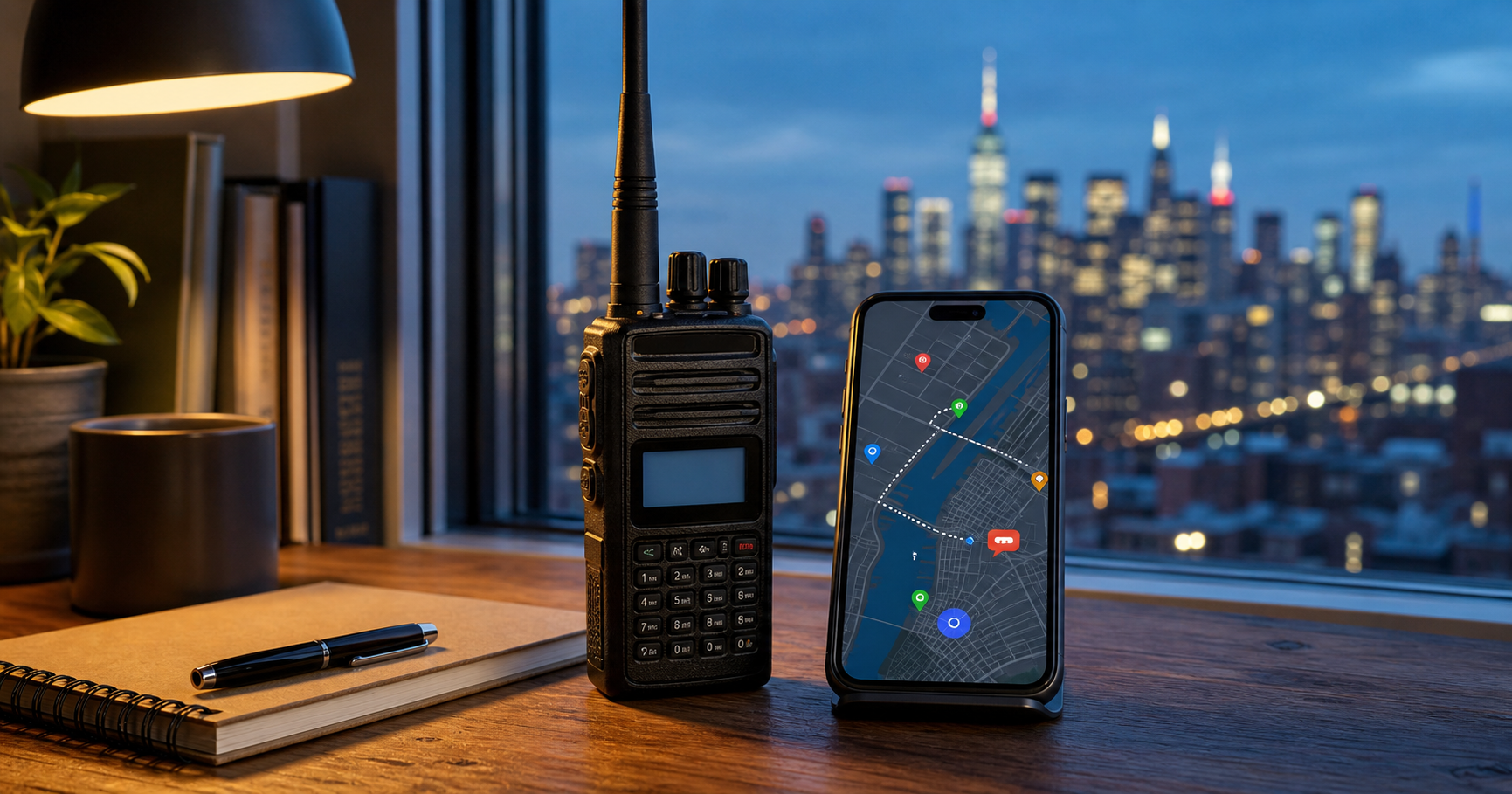
Illustrative image created with AI; equipment and map display are representative of my APRS station.
APRS—the Automatic Packet Reporting System—is often described as a way to track amateur-radio operators on a map. It can certainly do that, but APRS is capable of much more. It is a real-time digital communications system for exchanging locations, messages, weather information, objects, telemetry, alerts, and other useful data.
From my 17th-floor apartment in Brooklyn, I use APRS through several different paths: analog radio, BrandMeister DMR, APRS-IS, and mobile applications. Each method teaches me something different about how information can move through an amateur-radio network.
My particular interest is how APRS can support emergency communications. Knowing where operators, vehicles, shelters, hazards, and other resources are located can help turn scattered reports into useful situational awareness. For me, APRS is not merely another clever feature built into a radio—it is a capability worth learning, practicing, and understanding.
What Is APRS?
APRS was developed by amateur-radio operator Bob Bruninga, WB4APR. Unlike a conventional conversation between two stations, APRS uses short digital packets to share useful information across a network. Those packets may travel over radio frequencies, through internet-connected gateways called iGates, or by a combination of both.
Each APRS station uses a callsign—often followed by a numbered SSID—to identify a particular radio, vehicle, computer, or application. A station can transmit its position along with a symbol, brief status comment, course, speed, altitude, and other information. APRS also supports direct text messaging between stations and the placement of objects such as shelters, checkpoints, incidents, or other locations of interest.
The result is a shared, near-real-time picture of activity within an area. That makes APRS useful for everyday amateur-radio experimentation, public-service events, severe-weather reporting, search operations, and emergency communications.
How I Use APRS
My APRS experimentation involves several radios, applications, and network paths. This allows me to compare traditional APRS transmitted directly over amateur-radio frequencies with position reports and messages carried through internet-connected systems.
My primary APRS radio is the BridgeCom Maverick. I use it to transmit analog APRS position beacons on 144.390 MHz and to send location information through the BrandMeister DMR network. I have also experimented with the TIDRADIO TD-H9 as a dedicated analog APRS radio.
On my phone, applications such as the aprs.fi app for Android allow me to transmit, receive, and follow APRS activity through APRS-IS, the internet-connected side of the worldwide APRS network.
Living on the 17th floor has advantages, but operating from inside a Brooklyn apartment also presents challenges. Testing different radios, antennas, applications, and transmission paths helps me understand what works reliably—and what may not—before I ever need APRS in the field.
My APRS Stations
I use several APRS station identifiers to distinguish among my radios, applications, and network paths. Most use numbered SSIDs, while WB2EHG-D is the alphanumeric identifier associated with my digital hotspot. Each identifier represents a particular part of my station:
My Samsung Galaxy S25 Ultra running the aprs.fi app for Android.
My primary handheld for analog APRS position beaconing on 144.390 MHz.
A dedicated analog APRS handheld used for testing and experimentation.
WB2EHG-10 — BrandMeister DMR APRS
Fixed-position APRS reports sent through the BrandMeister network using my AnyTone D168UV.
The APRS station identifier associated with my digital hotspot.
APRS symbol artwork: aprs.fi symbol set by OH7LZB
APRS Nets I Check Into
APRS is also a way for amateur radio operators around the world to gather, exchange messages, and participate in scheduled check-ins. I regularly take part in several APRS-based nets:
APRS Sunday — APRSMY Malaysia APRS Net
A weekly APRS net hosted by the Malaysian APRS community.
Visit the APRSMY website
Tuesday — SARES Net
A weekly APRS net with check-ins recorded through the Hamfinity net dashboard.
Visit the SARES Net dashboard
Thursday — APRS Thursday
A worldwide weekly APRS activity encouraging operators to beacon, exchange messages, and make contacts through the APRS network.
Visit APRS Thursday
These nets give me another way to stay active on APRS, connect with operators beyond my local area, and explore APRS as more than simply a position-reporting system.
See my APRS Net Check-In Cards
View the cards I’ve received for participating in APRS nets and weekly check-in events.
Beyond Position Tracking
Position reporting may be the most visible feature of APRS, but it is only one part of the system. APRS stations can exchange short text messages, announcements, bulletins, weather reports, telemetry, and other useful information in near real time.
Operators can also place objects on the map to identify shelters, checkpoints, repeaters, hazards, event locations, or other resources. During a public-service event or emergency, these objects can help everyone develop a clearer picture of what is happening and where assistance may be needed.
I have experimented with APRS messaging and services such as ANSRVR, QRX, MPAD, and Winlink interaction. These tools demonstrate how a simple packet can request information, reach a group of operators, leave a message for later delivery, or connect APRS with another communications system.
That is what fascinates me most about APRS. It is not simply a collection of moving icons—it is a shared information network that amateur-radio operators can explore, adapt, and put to practical use.
APRS and Emergency Communications
My interest in APRS is closely connected to my interest in emergency communications. During an incident, voice radio remains essential, but spoken reports can be difficult to organize and easy to forget. APRS adds a visual layer by showing where operators, vehicles, shelters, checkpoints, hazards, and other resources are located.
Position reports can help a communications team understand where its people are deployed. Objects can mark important locations, while short messages and bulletins can distribute information without occupying a voice channel. Weather reports and telemetry can add still more detail to the common operating picture.
APRS is not a replacement for disciplined voice communications, formal message handling, or the Incident Command System. It is another tool—one that can support situational awareness when operators understand its capabilities, limitations, and network coverage.
That is why I continue to experiment with APRS before it is needed. Emergency communications equipment and procedures should be tested, practiced, and understood under ordinary conditions—not discovered for the first time during an emergency.
Follow WB2EHG Live
See where my APRS stations are reporting from, explore the radios and network paths behind them, and follow my ongoing experiments with analog APRS, APRS-IS, mobile applications, and the worldwide BrandMeister DMR network.