
New Ham Guide:
Radios and Antennas Guide
A practical beginner’s guide to choosing equipment that works together.
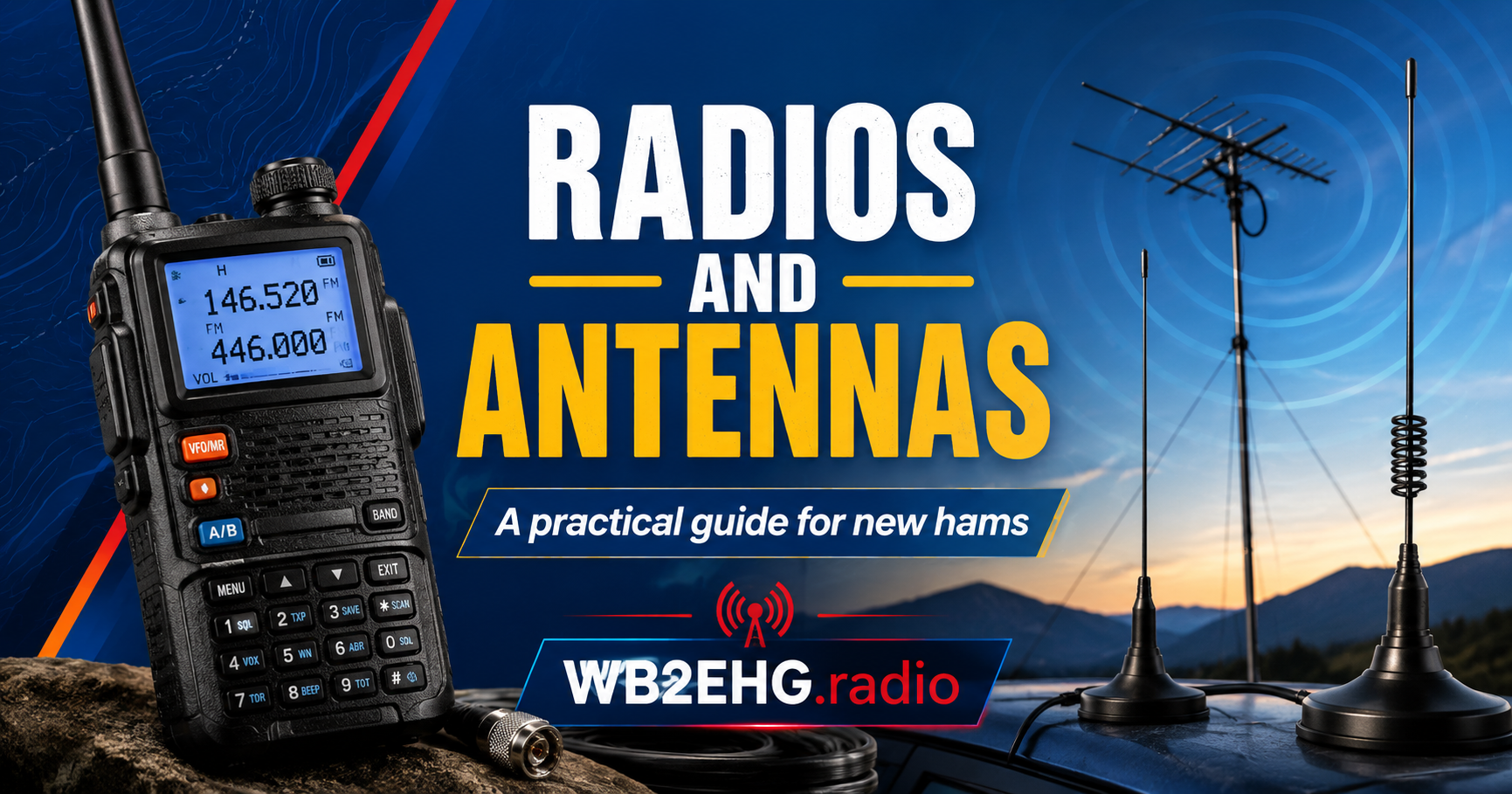
The Radio Is Only Half the Station
When I learned photography, I was taught that the camera body mattered, but the glass—the lens in front of it—often mattered more. Amateur radio works much the same way. The radio may contain the electronics, display, controls, and features, but every signal you transmit or receive must pass through the antenna.
A radio and antenna are a system. A fine radio connected to an inefficient or poorly placed antenna can be disappointing. A modest radio connected to an antenna that fits the band, location, and job can perform far beyond what its price might suggest.
That is why I do not begin by asking, “What is the best radio?” I begin by asking what kind of operating I want to do, where I will operate, and what antenna the radio will use there.
Start With the Job
Before choosing either a radio or an antenna, decide whether the station’s main role will be portable, mobile, or fixed. The previous guide, Deciding What You Want to Do, explains those roles in detail. Here we will connect each role to practical radio and antenna choices.
Portable
Portable usually means a handheld transceiver—an HT—that can travel on your belt, in a pocket, or in a bag. The priority is a useful balance of battery life, durability, controls, audio, features, and an antenna you can live with while moving around.
Mobile
Mobile operating usually means a radio installed in a vehicle, although an HT connected to an outside vehicle antenna can also work. A mobile setup must include safe mounting, electrical power, antenna placement, cable routing, and controls that do not distract the driver.
Base Station
A fixed station can be a dedicated base radio, a mobile radio powered from the wall, or an HT sitting on a desk. At home, antenna location and feed-line loss can matter as much as transmitter power. Apartment rules, available space, nearby noise, and what can be installed safely also shape the station.
One Radio Can Serve More Than One Role
These categories are starting points, not walls. An HT may be carried outdoors, connected to a vehicle antenna in the car, and used with a larger antenna at home. A mobile radio can live in a vehicle or become the heart of a desk station. Decide which role matters most now, then leave room to grow.
Bigger Is Better—Convenience Is Smaller
For antennas designed properly for the same band, a larger antenna generally has an advantage. It has more physical structure available to interact with the radio wave and is usually less electrically compromised than a very short antenna. That is why replacing a tiny stock “rubber duck” with a longer whip often improves both transmitting and receiving.
The tradeoff is convenience. A short antenna is less likely to catch on clothing, jab you while you sit, or make the radio top-heavy. It may be exactly what you want while walking around an event.
A longer whip is less convenient, but its improved performance may be worth it when reaching the repeater matters more than keeping the radio compact. The practical rule is simple: use the largest suitable antenna you can comfortably and safely use for the job.
What a Stock Antenna Is Designed to Do
The antenna included with an HT is usually designed as part of a portable package. It must be inexpensive, flexible, rugged, and short enough to carry. Those are reasonable design goals, but they require compromises in efficiency.
A stock antenna may work perfectly well when the repeater is strong and nearby. If signals are weak, noisy, or unreliable, the antenna is one of the first parts of the system to examine. Improving it is often a better first experiment than replacing the radio.
My $16 Lesson
After nearly two years of inactivity, I bought my BridgeCom Maverick but the stock antenna did not get me connected to any local repeaters from within my apartment. I then put a roughly $16 Nagoya NA-701 on my Maverick. That small change restored my belief that practical apartment operation was possible and helped bring my radios back to life. I later tried the longer NA-771 and found that, in my particular location and circumstances, it performed about the same. Today I use the NA-701 on the Maverick and the NA-771 on my TIDRADIO TD-H9.
That experience does not make either antenna a universal answer. It demonstrates the lesson: before blaming the radio, giving up on your location, or spending hundreds of dollars on another handheld, try a suitable antenna and test it under the conditions where you actually operate.
Read more about this on my Journal: The $16 Upgrade That Brought My Radios Back to Life
Match the Antenna to the Radio
An antenna must fit more than the connector. It must also be designed for the frequencies you intend to use and suitable for the way it will be installed.
Band and Frequency Range
Antenna listings may say VHF, UHF, dual-band, 2 meters, 70 centimeters, or provide a frequency range. Choose an antenna intended for the bands on which you will transmit. An antenna that happens to receive a signal is not necessarily suitable for transmitting on that frequency.
Many new Technicians use 2-meter and 70-centimeter FM. A dual-band antenna designed for those amateur bands is a sensible general-purpose choice. If one band is much more important to you, a single-band antenna designed for it may provide better performance.
Connector Type
Handheld radios commonly use SMA connectors, but SMA male and SMA female are not interchangeable. Some antennas also use BNC or other connectors. Check the radio and antenna descriptions carefully before buying.
An adapter can solve a mechanical mismatch, but every adapter adds length and leverage at the radio’s antenna jack. A long, stiff antenna or heavy cable can place stress on that connector. A short flexible adapter lead can reduce strain when connecting an HT to a larger external antenna.
Power Rating
Make sure the antenna and any adapters, mounts, feed line, or accessories can handle the transmitter’s power. This is rarely difficult with a typical HT, but it matters more as power increases.
The Whole Installation
The antenna, mount, feed line, connectors, adapters, and radio form one RF path. A poor connector, damaged cable, loose adapter, or unsuitable mount can erase the advantage of a good antenna. Judge the system, not merely the item with “antenna” printed on its package.
Placement Can Beat Price
Moving an antenna may improve a signal more than buying another radio. VHF and UHF signals are affected by buildings, walls, metal, terrain, and even your body. A shift of a few feet—or sometimes a few inches—can change the path.
Get It Higher
Height usually helps VHF and UHF communication because these bands depend heavily on line of sight. An antenna near a window, on a higher shelf, or above nearby obstructions may hear and reach stations that are lost from a low position in the room.
Keep It Clear
Your body absorbs and distorts some RF energy, especially when an HT antenna is pressed close to you. Hold the radio upright and give the antenna some clear space. Do not wrap your hand around the antenna or allow it to lie against metal objects.
Try More Than One Location
Apartments create reflections, blocked paths, and pockets where a signal is unexpectedly strong or weak. Test several places at the desk and around the room. One window may favor a repeater while another does not. Real-world testing at your location is more useful than assuming that a specification tells the whole story.
Practical Antenna Choices
You do not need to build the final version of your station all at once. Choose the simplest option that improves the job you are trying to do.
For a Handheld
The stock antenna offers maximum convenience. A longer replacement whip usually trades some convenience for better performance. A flexible roll-up antenna or portable vertical can be carried in a bag and deployed when you stop. An external antenna should be connected in a way that does not strain the HT’s antenna jack.
For an Indoor Station
A longer whip may be enough. Other possibilities include a magnetic-mount antenna placed on a suitable metal surface, a portable vertical near a window, or an antenna positioned higher in the room. A magnetic mount may depend on the metal beneath it as part of the antenna system, so follow the manufacturer’s instructions rather than treating any metal object as automatically suitable.
Indoor operating is often an exercise in finding the least-bad compromise. The goal is not to imitate a tower on the roof. It is to find a safe arrangement that gives you reliable access to the stations and repeaters you actually use.
For a Vehicle
Getting the antenna outside the metal body of the vehicle can transform an HT’s usefulness. A roof-mounted or magnetic-mount antenna generally has a clearer view and a better operating environment than a rubber duck inside the passenger compartment.
Placement matters. Near the center of a metal roof is often a strong location for an antenna designed to use that metal surface. Cable routing must avoid sharp edges, airbags, pedals, hot areas, and anything that could interfere with safe driving. Secure the radio and microphone, and do not let operating the station become a distraction.
For a Fixed Outdoor Station
When property rules, safety, and budget permit, an outdoor antenna placed higher and in the clear can provide a major improvement. The feed line becomes important because cable loss increases with frequency and length. A better antenna can be undermined by a long run of unsuitable or damaged coax.
Outdoor installations also introduce grounding, bonding, weatherproofing, structural, electrical-code, and lightning-safety questions. Follow applicable codes and manufacturer instructions, and get experienced local help when the installation goes beyond your knowledge. Disconnecting equipment during a storm is not a substitute for a properly designed protective system.
Feed-Line: The Road Between Radio and Antenna
Coaxial cable carries RF energy between the radio and an external antenna. Some of the signal is lost as heat along the way. Longer runs lose more, and loss becomes more significant at higher frequencies.
That does not mean every station needs the thickest, most expensive cable. A short portable run and a long rooftop run have different needs. Choose cable appropriate for the frequency, length, power, flexibility, and installation. Avoid crushing it, sharply bending it, pinching it in doors or windows, or leaving outdoor connections unprotected from water.
Use as few adapters and unnecessary junctions as practical. Label cables if you have several, and inspect connectors when performance changes unexpectedly.
Do You Need More Power?
Transmitter power matters, but it is not the first or only answer. If your antenna is inefficient, badly placed, or connected through lossy cable, increasing power may spend more battery and create more heat without solving the real problem.
Improve the signal path first: the correct antenna, better placement, sound connectors, and appropriate feed line. Then use the lowest power that provides reliable communication. Higher power remains useful when the path genuinely requires it, but it cannot replace an antenna that gives the signal a fair chance to leave the station.
Test Before You Replace
Change one thing at a time so you know what helped. Use the same frequency, location, radio, and power setting when comparing antennas. Ask for signal reports, listen to the noise level of a known signal, and repeat the test at more than one time if conditions or repeater activity vary.
Do not judge an antenna solely by how many display bars appear. Signal meters on handheld radios are not laboratory instruments. The useful questions are whether you can copy the other station clearly, whether the other station can copy you, and whether the connection is reliable enough for the job.
If you have access to an antenna analyzer or SWR meter appropriate for the band and power level, it can help identify problems. For a new operator, however, careful operating tests and help from a knowledgeable local ham can answer many practical questions.
Before You Buy an Antenna
What bands and frequencies will I transmit on?
Is the antenna intended for those amateur bands?
Does its connector match my radio?
Will its length and stiffness be practical for the way I carry or mount it?
Does the antenna require a metal ground plane or a particular type of mount?
If I need coax, how long will the run be and what loss is reasonable at my frequencies?
Will adapters or heavy cable strain the radio’s antenna jack?
Can I place the antenna higher or more clearly before buying anything?
Can I return the antenna if it performs poorly in my real operating environment?
A Sensible Upgrade Order
Confirm that the radio is programmed correctly and that the repeater or station can actually be reached from your area.
Test the radio from more than one location.
Replace the stock antenna with a suitable larger antenna.
Improve placement and height.
Add an external antenna when the operating role supports it.
Inspect connectors, adapters, mounts, and feed-line.
Consider more transmitter power only after the antenna system has been addressed.
What Comes Next: HF Antennas
VHF and UHF handheld antennas introduce the basic ideas: frequency, electrical length, placement, feed line, connectors, and tradeoffs. HF expands those same ideas into larger physical systems where antenna planning and feed-line choices become even more important.
Technicians already encounter antenna questions in license study and have limited HF privileges, including CW opportunities on several bands and voice, CW, and digital opportunities on 10 meters. Upgrading to General expands both the material you study and the frequencies and modes available to you.
HF antennas deserve their own guide. Wire antennas, verticals, tuners, counterpoises, grounding, common-mode current, and neighborhood constraints cannot be reduced to “buy the longest antenna.” The lesson from VHF and UHF still carries forward: the radio and antenna are one station, and the antenna is never an afterthought.
The Practical Bottom Line
Buy the radio that supports the kind of operating you want. Give it an antenna designed for the band and role. Use the largest suitable antenna you can reasonably live with, place it as high and clear as your situation safely allows, and treat every connector and length of feed line as part of the system.
Most importantly, test before you spend heavily. A modest antenna change may improve a station more than an expensive new radio. The goal is not to own the longest specification sheet. The goal is to put a dependable signal on the air and hear the person answering, “Hi. I’m Eric.”