The Radio is Now Half the Station
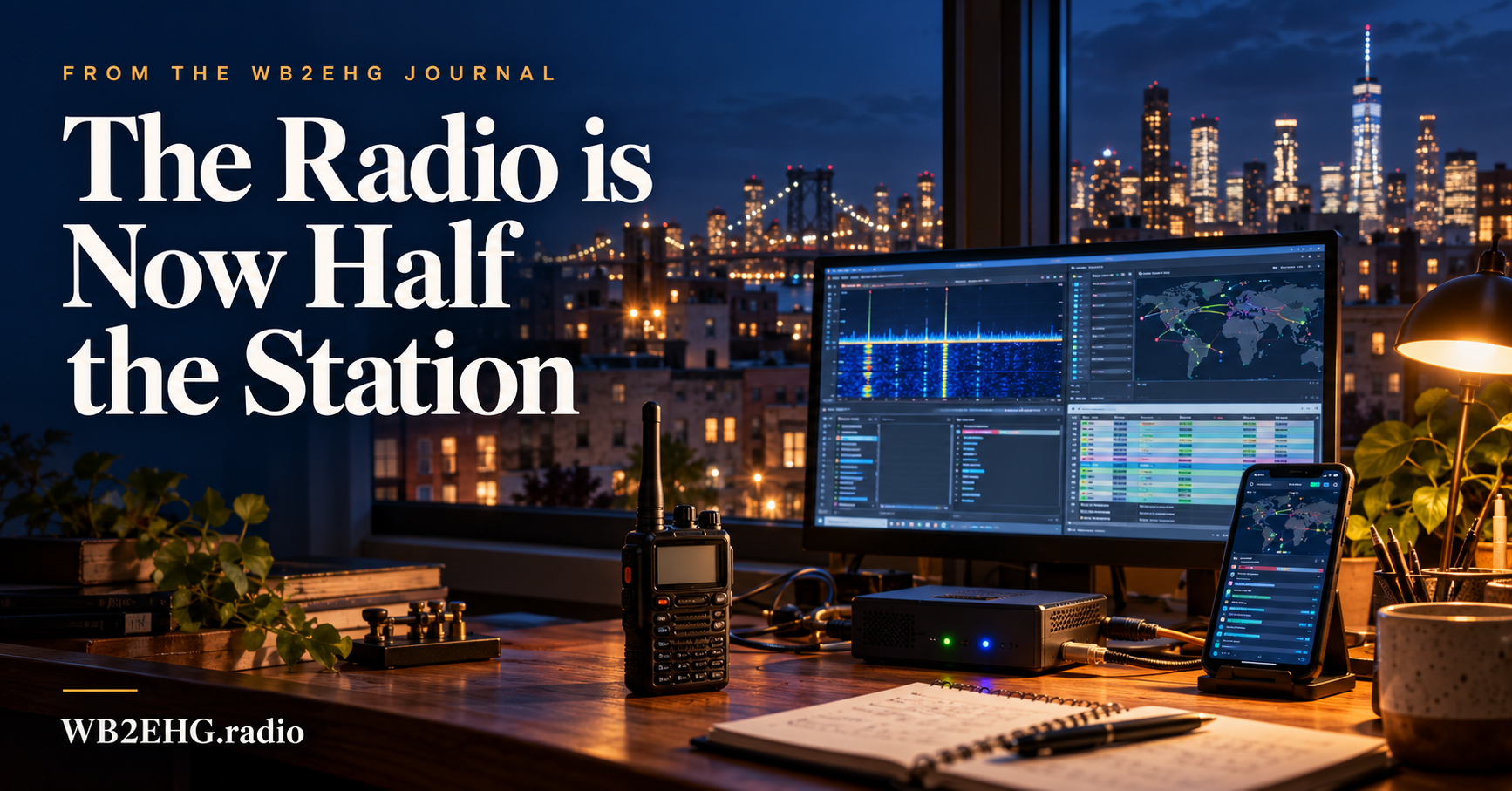
From codeplugs and packet decoders to APIs and a few stubborn cables, my station keeps finding new ways to help me make connections.
There is a handheld radio on my desk. It has an antenna, a speaker, a microphone and a button I press when I want to talk. If you asked me to point to my ham radio station, that would be a perfectly reasonable place to start.
Lately, though, I have been looking around the desk and realizing how much of the station lives outside the radio. There is a hotspot connecting a DMR conversation, a computer decoding APRS packets, a phone talking to the radio, a logbook keeping track of the people I meet, and a website showing some of that activity to the world. Somewhere among the cables and blinking lights, the boundaries of “the station” got a lot wider.
I find that thrilling. Every new piece gives me another way to listen, learn, experiment and, eventually, say: “Hello, I am Eric.”
The Conversation Starts Before I Press PTT
My BridgeCom Maverick is still a radio. It sends and receives RF. When I work a local repeater or hear an APRS packet arrive, the air between antennas matters. But before I press the push-to-talk button, I may have spent an evening in a codeplug deciding how a channel, contact, talkgroup or APRS setting should behave.
Then there is the HamSpot. A short radio signal gets from my handheld to the hotspot; the hotspot uses the internet to connect me to a DMR network. It is a different path from a direct radio contact across town, and knowing the difference matters. What delights me is where that path can lead. One moment I am at my desk in Brooklyn; the next I am hearing an operator in another state or another country. Sometimes the whole journey begins with me checking that I selected the right talkgroup.
The logbook is part of it, too. After a QSO, I can record the contact, check for a confirmation and see another little piece of my radio world take shape. The voice disappears when we sign off. The record helps me remember the person.
A Packet on the Screen
APRS has been especially good at expanding my idea of a station. My handheld can send a packet on 144.390 MHz. Another station may receive it and pass it along, and I can watch where it turned up. When I connect a radio to Dire Wolf, the computer listens to received audio and decodes the packets it can hear. Those little bursts of sound become callsigns, paths and messages on the screen.
That process is still capable of humbling me. I once spent time chasing noisy audio through a cable arrangement, only to discover that removing the extra booster cable gave Dire Wolf a usable signal. More recently, I swapped the radio receiving packets when one handheld’s battery was running down, and the decoding improved. I had changed both the radio and antenna, so I cannot claim which one made the difference. I could, however, see that the new combination worked.
That is the kind of discovery that can keep me at the desk far past a sensible bedtime. A packet appears. I wonder how it got there. I move a cable, change an antenna or check a setting, and suddenly the screen tells a clearer story about the signals reaching the seventeenth floor.
Tinkering Has New Tools
Tinkering has always been part of amateur radio. I picture earlier hams winding coils, soldering components, testing tubes and building antennas. I am happy to join that tradition, even if my bench sometimes looks more like a computer desk.
These days I can tinker with JSON, APIs, codeplugs, a Raspberry Pi, a USB audio cable or a small bit of code running on the web. I recently connected APRS OTA activity to the dashboard on WB2EHG.radio. The public page asks a Cloudflare Worker for the data; the Worker fetches and prepares it for the page. Seeing my activity appear there was every bit as satisfying as getting a stubborn piece of radio gear to work.
It also introduced me to CORS, one of those browser rules that sounds mysterious until it interrupts your project at 3:17 in the morning. The browser will not simply let a page request data from anywhere. Sometimes the useful answer is a little software relay between the page and the service. I learned enough to get that path working, and the next rabbit hole immediately waved hello.
I do not need to be an expert in every layer before I can enjoy exploring it. Curiosity, patience and a willingness to ask “What happens if I change this?” have taken me a long way.
The Point of the Whole Contraption
All of these tools have limits. The hotspot needs power and internet access. A web dashboard cannot hear a signal by itself. Dire Wolf only decodes the audio the radio manages to receive. Software can make a station more capable, but it can also create a new place for something to go sideways. I am learning those dependencies as I go.
Still, I love how much more I can do from a Brooklyn apartment with handheld radios and no outdoor antenna. I can call a local net, follow a packet over the air, join a distant conversation through DMR, or revisit a QSO in my log. When a piece of the setup finally works, I get that little jolt of joy: look what this lets me do now.
The radio may be half the station these days. The rest includes a phone, a computer, networks, cables, software and the occasional muttered question directed at a setting that worked perfectly yesterday.
And at the center of it is the same simple reason I picked up a microphone in the first place. Somewhere on the other end is another person. I press PTT, take a breath and say, “Hello, I am Eric. WB2EHG.”
73,
Eric — WB2EHG