The Value of a Volunteer
As I prepare to volunteer with EventHams at the 2026 New York City Marathon, I find myself thinking about the people who make something like that possible. The runners will have their miles to cover. Those of us volunteering will have our own jobs to do, including helping information get where it needs to go.
I am looking forward to doing my part. And somewhere between thinking about radios and getting ready to serve, an old question has come back to me: what makes someone go home glad they volunteered?
Over the years, I have spent plenty of time on both sides of that question.
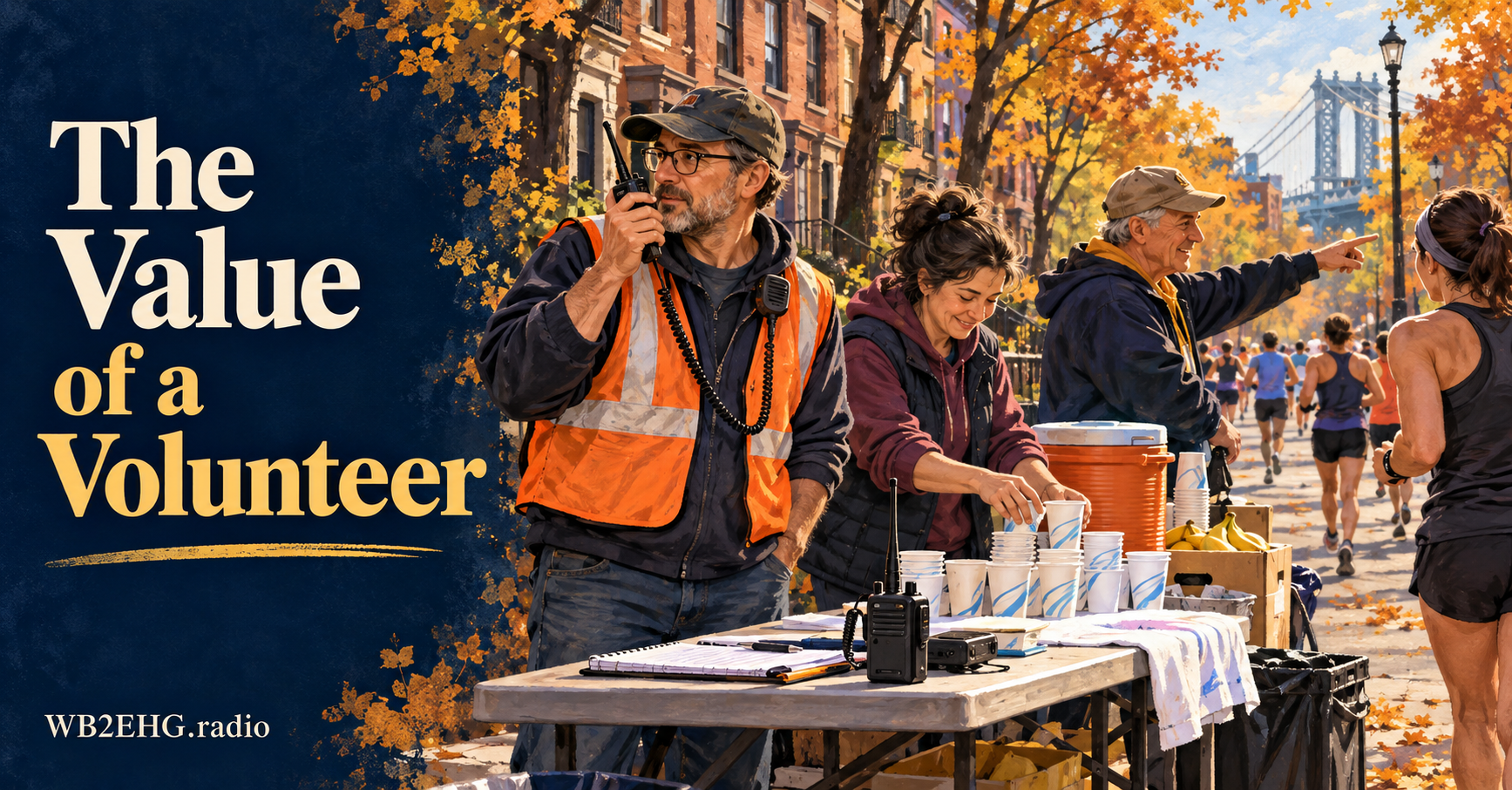
Giving our time, doing our part, and helping one another. Conceptual AI-generated illustration for WB2EHG.radio.
The Time Someone Gives
My volunteer life has included serving with the United States Coast Guard Auxiliary, with leadership responsibilities at the national level; serving as Brooklyn Borough Coordinator for CERT volunteers under NYC Emergency Management; serving as a volunteer leader with New York Road Runners; and serving with Kings County REACT. Amateur radio emergency communications and public service continue that thread today.
Those experiences put me alongside people with very different lives who had made the same choice: to give some of their time to help.
Time is an extraordinarily valuable thing. A volunteer's shift comes out of a life already full of other possibilities and responsibilities. There is family time, work, leisure, or simply a chance to put their feet up. When someone agrees to serve, something else has to wait.
I always felt that accepting that gift gave me a responsibility. A good volunteer leader doesn't simply ask people to show up. A good leader makes their showing up worthwhile.
Every volunteer has a personal reason for being there. Maybe they care deeply about the mission. Maybe they enjoy the company, want to learn something, or find satisfaction in being useful. Their reason may be something they would never think to explain to me.
I don't necessarily need to know what that reason is. But I had damn well better RESPECT that they have one.
For me, that respect has practical consequences. Have an assignment ready. Explain what needs doing and why it matters. Give people the information and support to do it. Listen when they raise a concern. Remember that they may need a break, and that their lives continue after the shift ends.
Nobody can promise an operation will run perfectly. Plans change, and sometimes waiting is part of the work. But people deserve to understand what is happening. Their willingness to help shouldn't become permission to waste their time.
And when the work is done, thank them. A real thank-you, with some understanding of what they contributed, means a great deal.
Remembering Carlos
When I think about the people I served with in CERT, I think about my friend Carlos Nieves.
Carlos was a wonderful man. He would accept virtually any assignment with the same goofy grin and a simple “OK.”
Managing traffic at a street corner? Leading a team? Cleaning the latrines? Carlos brought the same cheerful willingness to all of it. He understood that service meant doing what needed to be done, whether or not the assignment came with a title or looked particularly glamorous.
I remember that grin with great affection. There was something about Carlos that made his willingness feel uncomplicated. The work needed doing, and he was willing to do it. I was fortunate to know him and to serve alongside him.
Tragically, Carlos died after suffering a heart attack while responding to a call for service. Losing him hurt. When I remember him now, I want people to know the man we lost, including the humor and good nature he brought with him.
After his death, I proposed to NYC Emergency Management that an award be named in Carlos' honor. NYCEM chose to name its CERT Team of the Year Award after him.
At the first presentation of the award bearing his name, Carlos' sister was invited as a guest of honor. I was able to witness how the team receiving the award knew who Carlos was and understood what his name on that award meant.
They treated his sister like royalty.
That remains one of my most meaningful memories of volunteer service. Carlos was being remembered by people who understood and valued the way he had served. His sister was welcomed with that same appreciation.
I am grateful to that team for how they treated her. And I am grateful that Carlos' name became part of recognizing the service of others. I still miss my friend.
The View From the Other Side
These days, I am often what I jokingly call a “plain ol', run-of-the-mill, individually contributing volunteer.” Quite a mouthful for somebody who just wants to show up and help.
I am perfectly comfortable with that. I can bring what I know, follow the plan, and do my assignment. Somebody else can manage the operation. I don't need a title, and I don't expect preferential treatment because I once held one.
There is satisfaction in having a particular job to do and giving it my attention. My previous experience is useful when it helps me contribute. It also reminds me to respect the people carrying the responsibility for the whole operation.
Being on this side of the relationship does make me notice things. Do I know where to report? Is my assignment clear? Can I ask a question without feeling like a nuisance? Does someone recognize that I have set aside part of my day to be there?
I expect the same preparation, consideration, and appreciation that I believed volunteers deserved when I was responsible for them. Those expectations apply to every person who shows up.
This is a reflection on my own change of perspective, rather than a complaint about current leadership. Years of working with volunteers stay with me. Now I get to experience that relationship from the other direction, with a little less directing and a little more listening.
Showing Up for the Marathon
That is what I am bringing with me as I get ready for the NYC Marathon: my radio, my willingness to help, and an appreciation for everyone else making room in their lives to be there.
An event like this gives ordinary people a chance to contribute their time and talents to something much larger than their individual assignments. Amateur radio is one way I can take part. I want to be prepared, follow instructions, and be someone my fellow volunteers can count on.
I think about Carlos, too. I remember his grin and his readiness to accept the work in front of him. I am glad I knew him.
Whether I am helping organize volunteers or standing alongside them, the measure I care about is the same. The real measure of volunteer leadership isn't how many people show up. It's whether they go home feeling glad they did.
At the end of my shift, I hope to share that feeling with the people around me:
“Now THAT'S why I volunteered!”