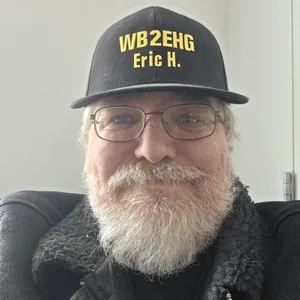
FROM BROOKLYN TO THE WORLD: The Maverick and HamSpot 5
How my BridgeCom Maverick and HamSpot 5 became the heart of my daily DMR operating
A handheld radio, a little box beside my computer, and an internet connection have turned my Brooklyn apartment into a doorway to the world. The technology is impressive. The people on the other side of it are the point.
On my desk in Brooklyn sits a BridgeCom Maverick handheld radio. Nearby is a HamSpot 5, a small digital hotspot built and configured for me by Collin, K0NNK. Neither one looks particularly dramatic. There are no glowing tubes, no giant beam turning on the roof, and no wall full of equipment humming behind me.
But when I pick up the Maverick and key TalkGroup 91, that little station opens onto the entire world.
My first contact through this setup was with Italy. No elaborate ceremony. No weeks of troubleshooting. Collin had custom-configured the HamSpot before delivery, so it really was plug-and-play: power it up, connect the Maverick, kerchunk 91, listen, and wait. Then came a voice from Italy.
Brooklyn to Italy, through a handheld radio sitting on my desk.
That will get your attention.
The Pairing
The Maverick is the most capable handheld I own. It handles analog and DMR, GPS, APRS location reporting, roaming, messaging, recording, weather alerts, and enough other functions to keep an inveterate button-pusher entertained for a very long time. Mine is also my primary everyday radio—not something I keep in a box for special occasions.
The HamSpot 5 is the quiet half of the partnership. It is a full-duplex MMDVM hotspot built around a Raspberry Pi 5 and managed through WPSD. It supports several digital voice modes, but my everyday use is DMR. The hotspot connects to the digital network through the internet, while the Maverick talks to the hotspot over radio. In effect, it gives me my own very-low-power doorway into the DMR network.
Could I have bought parts and built a hotspot myself? Probably. I have never been especially afraid of technology. But there is also something to be said for equipment that arrives configured by the person who built it and simply works. I turned it on and started operating. That is worth a great deal—especially when what I want to do is talk to people, not spend every evening rebuilding the doorway.
The HamSpot 5 originally arrived configured for duplex operation. In my station, simplex proved more stable, so that is how I now run it. That is one of the things I like about amateur radio: “plug-and-play” does not mean “never learn anything.” It means you get on the air quickly, then learn, adjust, and make the station your own.
My Nightly Routine
I keep a Chrome tab group for DMR operating. It opens WPSD, World Radio League, my QRZ Logbook, aprs.fi, and a live DMR activity page for TalkGroup 91. That sounds like mission control, but the actual ritual is simple.
I open the tabs. I check the hotspot. I kerchunk 91 and listen.
Sometimes I wait for a station from a country I have not worked before. Sometimes I simply call CQ. If someone answers, the contact begins the same way every good contact does: with two people saying hello.
Afterward, I log the QSO in World Radio League, which automatically populates QRZ. Then I send a DigiQSL. The software handles the clerical work, but the memory is still mine: Moldova. India. Italy. Japan. Canada. A call sign appears on the screen, a voice comes through the Maverick, and another little line is drawn across the globe from my desk in Brooklyn.
There is a rhythm to it now. What once looked like a collection of unfamiliar menus, talkgroups, color codes, time slots, IDs, and dashboards has become second nature.
“DMR Is Too Complicated”
I understand why people say DMR is confusing. Programming a DMR radio is not the same as typing a repeater frequency into an analog handheld. There are more pieces, and the language can be unfamiliar at first. A codeplug can look intimidating until you understand what its parts are doing.
But hams have always been at the forefront of technology. We built stations from parts, bounced signals off the moon, linked repeaters, experimented with satellites, packet radio, and digital modes, and connected computers to radios long before any of that was ordinary. Learning DMR belongs to that tradition.
I figured it out. Now it is just radio.
That does not mean I know every corner of every menu, or that nothing ever needs troubleshooting. It means I understand my station well enough to operate it, maintain it, and recognize when something is not behaving normally. That is a perfectly respectable definition of knowing your equipment.
And the payoff is enormous. If you cannot put up an HF antenna, cannot afford a complete HF station, live under antenna restrictions, or—as I do—operate from a 17th-floor apartment in Brooklyn, you can still talk to the whole world.
Citizenship in the World
When I was a Scout, my favorite merit badge was Citizenship in the World. That probably says something about me. I have always thought of myself as a global citizen. Borders are real, cultures matter, and distance matters—but none of them cancels our shared humanity.
TalkGroup 91 feels like that merit badge brought to life.
I can sit at home, pick up a handheld, and speak with another amateur thousands of miles away. We may exchange names, locations, radios, weather, and signal reports. We may speak for two minutes or twenty. It does not have to be a profound geopolitical summit. The profound part is that the connection is possible at all—and that two strangers chose to make it.
Some people look at a hotspot and see “radio over the internet,” as though the internet somehow makes the radio less real. I see layers of technology working together to let amateur operators reach one another. The Maverick is a radio. The HamSpot is radio equipment. DMR is a radio mode. The network extends their reach. None of that diminishes the contact.
The technology is the path. The human voice is the destination.
Because Upgrade
Could I operate DMR with less equipment? Certainly. Do I own other handhelds that can get onto DMR? Yes. But the Maverick and HamSpot 5 have become the heart of my daily station because together they are capable, dependable, and pleasant to use.
Also: because upgrade. Hehehe.
Amateur radio has always had room for that, too—the delight of a new radio, a more capable box, a better antenna, or one more screen on the desk. The gear is fun. I will never pretend otherwise. But gear becomes meaningful when it serves a purpose.
This gear serves mine.
Each night, it gives me a doorway from Brooklyn to voices around the planet. It helps me maintain a daily operating habit. It gives me new countries to log, new callsigns to recognize, and new people to meet. It turns a small corner of my apartment into a genuinely international radio room.
I kerchunk 91. I listen. I wait for a voice from somewhere I have never been.
Then I press the PTT and say the thing amateur radio has always been about:
“Hi. I’m Eric. WB2EHG in Brooklyn, New York.”