Signals from the Old Stone House
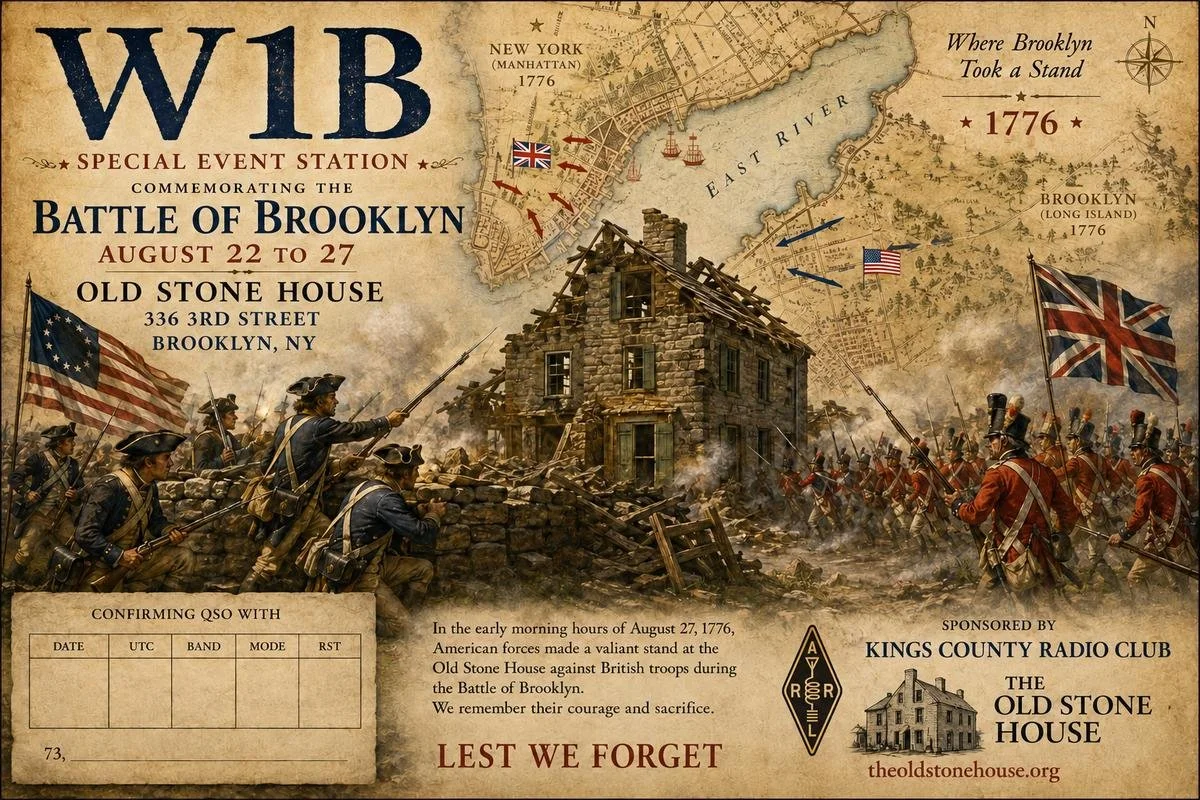
QSL Card for Special Event Station W1B commemorating the Battle of Brooklyn August 22 to 27 at the Old Stone House, Brooklyn, N.Y.
My first Kings County Radio Club field activity connected Brooklyn's past with amateur radio's present - and gave Arlene and me a glimpse of what HF might someday look like in our apartment.
On Saturday, Aug 29, 2026, my YL Arlene and I arrived at Brooklyn's Old Stone House at about 11 in the morning. We were early, but that was fine with me. This was my first Kings County Radio Club activity, and I did not know anyone there.
The first thing I noticed was the antenna beside the house. Then I saw the tent, with several hams gathered around radios spread across tables. There was no mistaking what was happening. KCRC had put special-event station W1B on the air to commemorate the 250th anniversary of the Battle of Brooklyn.
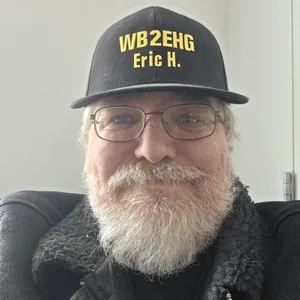
I walked up wearing my WB2EHG hat and offered the simplest introduction possible:
"Hi, I'm Eric."
The hat supplied the rest.
A Historic Place for a Radio Signal
The Battle of Brooklyn was fought on Aug 27, 1776, only weeks after the Declaration of Independence. It was the first major battle fought by the new United States and the largest battle of the American War for Independence. Near the Old Stone House, roughly 400 Maryland and Delaware soldiers mounted repeated charges against a much larger British force. Their stand bought precious time for other American troops to retreat across Gowanus Creek toward Brooklyn Heights.
Two hundred and fifty years later, the sounds around the Old Stone House were not musket volleys but voices and digital signals carried by radio.
Lloyd Westerman, K2JVX, had organized KCRC's W1B special-event station for the anniversary. I did not need anyone to give me a tour of the radio setup. Although I was new to the people, I was not new to radio. I could see the antennas, equipment, and operating positions for myself.
So I sat down and did what hams do especially well: I rag-chewed.
Contacts Without Taking the Microphone
I never operated the W1B station, and I was perfectly all right with that. My BridgeCom Maverick remained tuned to the KC2RC club repeater, which I quietly monitored while sitting with the group.
Being part of a special-event station does not always require taking the microphone or putting your own name in the log. Sometimes participation means listening, talking with other operators, watching the station work, and helping other people understand why it is there.
During our time there, W1B completed contacts with Serbia and California. Think about that for a moment: a signal leaving a small tent beside one of Brooklyn's most historic buildings and reaching both across the continent and across the Atlantic. From ground once defined by isolation, confusion, and battle, amateur radio was now creating connections.
That contrast stayed with me.
Explaining the Station to Brooklyn
The antenna and radio tent naturally attracted the attention of people passing the Old Stone House. When they stopped to ask what was happening, I had an opportunity to become an informal public face for the event.
I explained that we were amateur radio operators commemorating the Battle of Brooklyn. But the station represented more than history. I also told them that we were demonstrating how amateur radio operators could establish a remote emergency-communications capability when it was needed.
The same basic skills were visible all around us: bringing radios and antennas to a field location, setting up an independent station, establishing contacts over distance, and communicating beyond the immediate area. On this day, the purpose was commemorative. During an emergency, that deployable capability could help connect people and communities when normal systems were unavailable or overloaded.
I had not taken the W1B microphone, but I was contributing in another way - helping our Brooklyn neighbors understand both what amateur radio was doing that afternoon and what it could do on a much more difficult day.
Showing Arlene What HF Could Be
The most personally valuable part of the day happened at a second radio setup. It was monitoring FT8 with a magnetic-loop antenna.
HF has been difficult to picture in our home. We live on the 17th floor of a Brooklyn apartment building, without access to outdoor antennas. A conventional HF antenna is not something we can simply string across a yard we do not have. A magnetic loop, however, is compact enough to suggest another possibility.
Arlene could see that.
For perhaps the first time, I was able to show her an actual HF setup instead of merely describing one. She could see the radio, the computer-based FT8 activity, and the loop antenna working together. More importantly, she could imagine how something similar might fit into our apartment.
She showed real interest in the idea.
I also explained that the true investment in a complete HF station remains beyond our present budget. A workable station is more than one attractive radio or one clever antenna. I did not want the demonstration to create an unrealistic impression that we could reproduce everything immediately.
Still, "not now" is not the same thing as "never." The magnetic loop changed HF from an abstract possibility into something we could both visualize.
My First KCRC Activity
Arlene and I stayed until about 2:30 that afternoon. I left without having made a contact as W1B, but I did not feel that I had missed anything.
I had arrived not knowing anyone. I introduced myself with three words and a callsign on my hat, sat beneath the tent, and joined the conversation. I watched a Brooklyn special-event station reach Serbia and California. I explained to passersby how a field station like this one could become an emergency-communications resource. I saw amateur radio bring the history of the Old Stone House into the present. And I was able to share with Arlene a clearer picture of a part of the hobby I may someday explore from home.
My first KCRC field activity was not about how many contacts I made. It was about community, public service, possibility, and being there.
Sometimes the most meaningful radio day is not the one when you hold the microphone. Sometimes it is the day when you sit among other hams, listen to signals travel beyond the horizon, and begin to imagine what might come next.
73, Eric - WB2EHG
AI-assisted image created with ChatGPT for WB2EHG.radio.