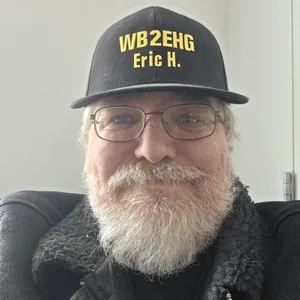
Why I Like DMR - Worldwide radio, familiar voices, and the people behind the network
“The technology is only the bridge.
At the other end is another person with a callsign, a radio, a location, and a story.”
When I returned to amateur radio, Digital Mobile Radio (DMR) was one of the things that really pulled me in. I enjoy analog radio, APRS, emergency communications, and experimenting with whatever else catches my attention, but DMR quickly became a central part of how I operate. It gives me something I have always valued in radio: an easy way to meet people I would never otherwise encounter.
From my apartment in Brooklyn, New York, I can turn on my handy talkie radio and talk with another amateur across town, across the country, or on the other side of the world. On BrandMeister Talkgroup 91, I have spoken with operators in Moldova, India, Italy, Japan, and Canada. There is still something remarkable about pressing the push-to-talk button in Brooklyn and hearing a voice come back from thousands of miles away.
Yes, I understand that the internet is involved. Someone will inevitably point that out whenever DMR is discussed. But the internet is simply part of the infrastructure that connects the radio systems. I am still using an amateur radio, identifying with my FCC-issued callsign, following normal operating practices, and speaking with other licensed operators. DMR does not become meaningless merely because the signal takes a different route.
In fact, I like the way DMR combines radio with modern networking. Talkgroups let me choose the kind of community or conversation I want to join. I can use a local repeater, connect through my HamSpot 5 hotspot, visit a worldwide talkgroup, or check into a regular net. It gives one handheld radio an extraordinary amount of reach and flexibility.
The heart of my DMR station is my BridgeCom Systems Maverick and the HamSpot 5 built by Collin, K0NNK. The Maverick is my primary handy talkie, giving me DMR, analog, and APRS in one radio that I can use at my desk or carry with me. At home, the HamSpot 5 gives me a dependable personal path into the BrandMeister network without requiring me to reach a local repeater from inside my apartment. Together, they give me a compact station with worldwide reach—an impressive amount of capability from two pieces of equipment that take up very little room.
DMR has also helped me establish a regular operating routine. I frequently check into the East Coast Reflector Morning Brew, and I can reach the Octane Reflector through my friend Chris’s DMR repeater over in Staten Island when I am away from my home hotspot. At other times, I may spend an evening listening to Talkgroup 91 until I hear someone calling for a contact. Those regular destinations begin to feel like familiar rooms: you walk in, listen for a while, and eventually recognize some of the voices.
I particularly enjoy the unpredictability of the worldwide talkgroups. I never know who will answer. It may be someone a few states away or someone sitting in a radio room halfway around the planet. We may talk about our radios, our locations, the weather, or whatever happens to come up. Some contacts last only a minute or two. Others become actual conversations. Either way, another callsign and another human story enter my logbook.
That accessibility matters to me. I live on the 17th floor of an apartment building, where installing a large outdoor antenna system is not a simple proposition. I am also still a Technician-class operator, and a major HF station is not currently practical for me. DMR lets me enjoy worldwide amateur-radio contacts with equipment that fits comfortably on my desk and within my present circumstances.
DMR is not the only kind of amateur radio I want to explore, nor do I see it as a replacement for analog repeaters, simplex, satellites, APRS, or HF. Each part of the hobby offers something different. There is a special satisfaction in making a contact through antennas, atmosphere, and propagation alone. But that does not diminish what DMR offers. I do not believe we need to reject one part of amateur radio to appreciate another.
The technical side is fun, too. Building codeplugs, programming channels and talkgroups, configuring a hotspot, and learning how the networks fit together all appeal to the systems-thinking part of my brain. When everything is finally configured correctly and a distant voice comes through the speaker, there is a genuine sense of accomplishment. Of course, when the radio stubbornly refuses to behave, there may also be some language unsuitable for a family publication. I mean, my first language is not English, but Brooklynese!
The People Behind the Network
I also owe a few shoutouts to the people and communities that have helped make DMR so enjoyable for me. My friend Chris W2CSW Wiackly gives me access to the Octane Reflector through his repeater. The regulars on the East Coast Reflector Morning Brew have made checking in part of my routine. Then there are all the operators who monitor Talkgroup 91 and answer calls from strangers—including one particular stranger sitting in his apartment in Brooklyn, New York.
Jeremiah W9JAM Mulford at BridgeCom Systems also deserves special recognition. He has patiently helped me through more than one issue with my BridgeCom Maverick, and somewhere along the way, he became more than just a support person—he became a friend. Good equipment matters, but knowledgeable support from someone who genuinely wants you to succeed makes an enormous difference.
I also appreciate World Radio League and QRZ.com for giving me places to record these contacts and watch my progress. Logging each QSO turns a brief conversation into part of a larger story. The streaks and awards give me something to work toward, including the QRZ DX World Award and, eventually, the DX100 World Award. They are not why I get on the radio, but they add another enjoyable dimension to operating.
Finally, a shoutout belongs to the worldwide DMR community itself. Every operator who answers a call, welcomes someone into a net, helps a newcomer with a codeplug, or takes a few minutes to explain how something works contributes to the hobby. DMR may be built from radios, repeaters, hotspots, servers, and networks, but it is sustained by people.
What keeps me returning, however, is not the technology itself. The technology is only the bridge. At the other end is another person with a callsign, a radio, a location, and a story. That is what amateur radio has always been about for me.
DMR makes it possible for me to sit at my desk in Brooklyn, press one button, and open a door to the world. Then I get to say the words that are ultimately at the heart of everything I enjoy about radio:
“Hi. I’m Eric.”